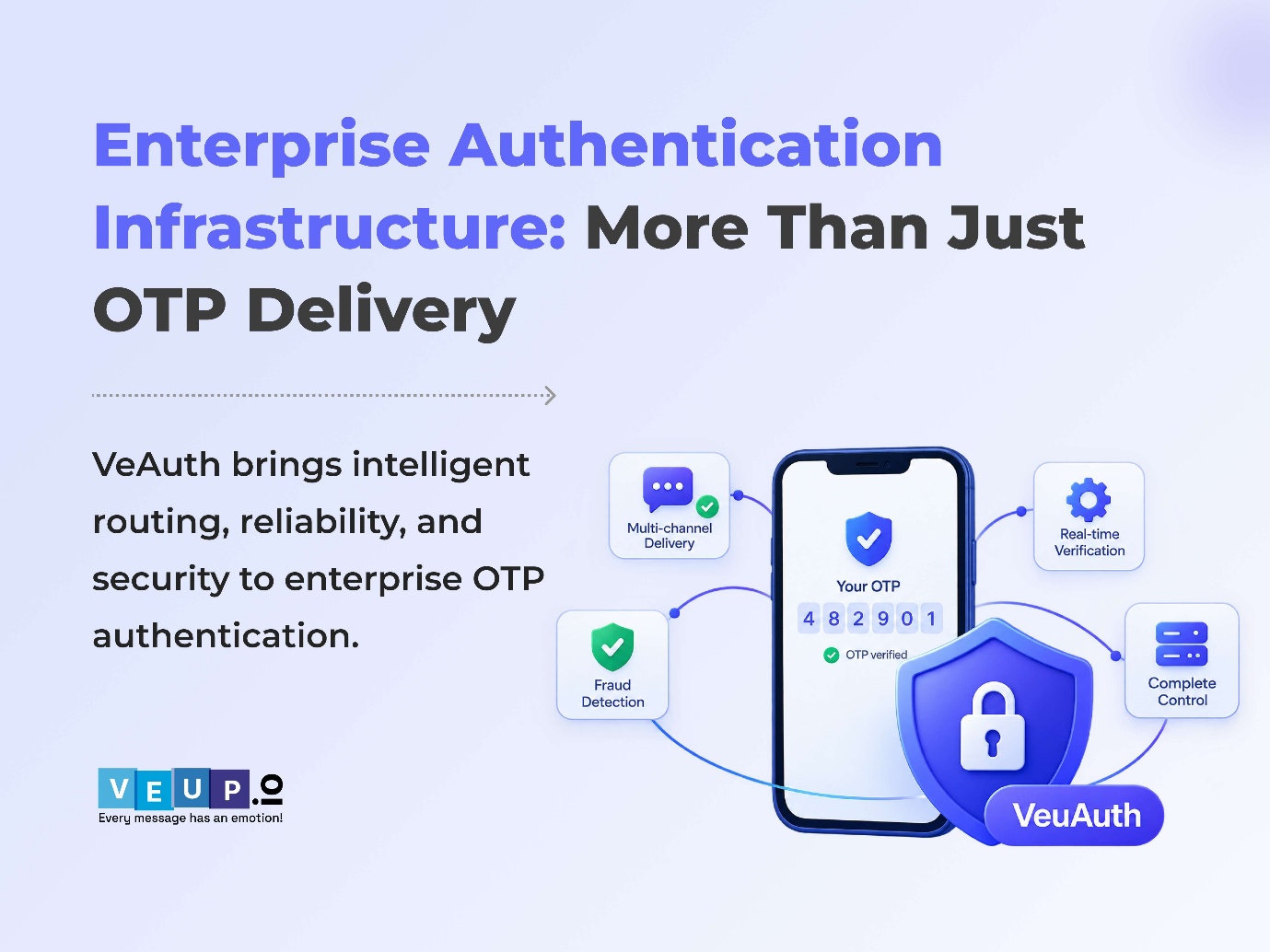
VeUp Technologies introduces VeAuth, an authentication engine built to treat OTP delivery as mission-critical infrastructure rather than a single SMS transaction.
Every digital account opening, every payment authorization, every login to a banking app begins with the same small, largely invisible transaction: a one-time password sent, received, and verified within seconds. It has become the default trust mechanism of digital India — and, increasingly, its most exposed point of failure. When an OTP arrives late, arrives never, or arrives after a fraudster has already intercepted a customer's SIM, the cost is rarely small. It shows up as an abandoned onboarding flow, a failed payment, a regulatory incident, or a customer who no longer trusts the app.
VeUp Technologies, a Bengaluru-based enterprise communication infrastructure provider, is addressing that exposure with the introduction of VeAuth, an enterprise OTP authentication engine designed to manage the full lifecycle of authentication — not merely to send a message and hope it arrives.
Digital Identity Has Outgrown Simple OTP Delivery
The scale of digital identity verification in India has changed the nature of the problem. Banks, NBFCs, insurers, and e-commerce platforms now authenticate customers dozens of times across a single relationship — at onboarding, at login, at every payment, at every policy change. Each of those moments depends on an OTP arriving quickly and correctly, through a chain of telecom operators, aggregators, and gateways that was never designed with authentication-grade reliability as its primary goal.
This dependency has produced a familiar set of enterprise pain points. Authentication failures during onboarding directly translate into drop-off — a prospective customer who cannot complete KYC in one sitting is a customer an institution may never recover. Delivery inconsistency varies by circle, operator, and time of day, meaning the same OTP infrastructure that works reliably in one region underperforms in another. Fraud risk compounds the problem: SIM swap attacks, in particular, have turned the OTP itself into an attack surface, where compromising a customer's phone number can be enough to bypass what institutions treat as a strong authentication factor. And compliance requirements across BFSI and healthcare demand audit trails and delivery evidence that a simple send-and-forget SMS gateway was never built to provide.
The result is that OTP has quietly become a single point of failure sitting underneath some of the most sensitive transactions an enterprise handles — while being managed, in many organizations, with far less rigor than the systems it protects.
From Message Delivery to Authentication Infrastructure
VeUp's central argument behind VeAuth is a reframing: OTP delivery is not a messaging problem to be solved once and left alone — it is an infrastructure problem that requires the same discipline applied to core banking or payment systems.
That distinction shapes VeAuth's design. Rather than functioning as a single OTP gateway with one delivery path, VeAuth manages the entire OTP lifecycle — generation, intelligent routing, delivery, verification, expiry, and retry — as a coordinated process, with visibility at every stage rather than only at the point of dispatch.
Inside VeAuth: Architecture Built for Reliability and Security
OTP lifecycle management. VeAuth treats each OTP as a tracked transaction from generation through expiry, rather than a fire-and-forget message, allowing enterprises to see exactly where in the process a failure occurred when one does.
Intelligent routing and delivery optimization. OTPs are routed dynamically across channels and providers based on live delivery performance by region and operator, rather than a fixed, pre-configured path that degrades silently when conditions change.
Security architecture. Authentication traffic is handled with security controls appropriate to its sensitivity — encryption in transit, expiry enforcement, and safeguards designed to reduce exposure to interception and replay, addressing the reality that OTPs are now a direct target for fraud rather than a neutral utility.
Enterprise scalability and high delivery success. Built to sustain high-volume authentication traffic during peak periods — a bank's month-end payment cycle, an insurer's renewal season, an e-commerce platform's sale-day login surge — without the delivery degradation that strains single-vendor gateways under load.
An Industry Perspective: Authentication as Mission-Critical Infrastructure
The stakes vary by sector, but the underlying pattern is consistent. A bank cannot afford OTP failure at the moment of a high-value transfer. An NBFC processing loan disbursements needs authentication that holds up during month-end volume spikes. An insurer verifying identity during a claims process is handling a moment of genuine customer stress, where a failed OTP compounds an already difficult interaction. A hospital network authenticating patient portal access is handling data with its own regulatory sensitivity. A government service authenticating citizens at scale cannot tolerate regional delivery gaps. And an e-commerce platform processing thousands of logins during a flash sale needs authentication that scales with demand rather than becoming the checkout flow's weakest link.
"Authentication is the one part of the customer journey where there is no room for a second attempt at trust," said Pankaj Jain, CEO of VeUp Technologies. “If an OTP fails, the customer doesn't blame their telecom operator — they blame the bank, the insurer, the platform they were trying to use. VeAuth was built because enterprises need to treat authentication as infrastructure they control, not a message they hope arrives.”
The Future of Authentication Is Adaptive, Not Static
As digital transaction volumes grow and fraud tactics evolve, static, single-channel OTP delivery is unlikely to remain sufficient on its own. The next phase of authentication infrastructure will need to adapt in real time — routing intelligently around delivery failures, recognizing fraud patterns as they emerge, and extending across channels as customer preferences shift, while still meeting the compliance and audit standards that regulated industries require.
VeUp's positioning of VeAuth reflects that trajectory: authentication built to function as a resilient, monitored system rather than a single gateway that either works or doesn't. For CIOs, CTOs, and compliance leaders across banking, insurance, healthcare, and digital commerce, the question VeAuth raises is not which OTP vendor to use, but whether authentication itself has been engineered with the reliability the rest of the technology stack already demands.
VeUp Technologies is headquartered in Bengaluru and serves enterprise clients across banking, financial services, insurance, healthcare, government, and e-commerce. More information is available at veup.io.