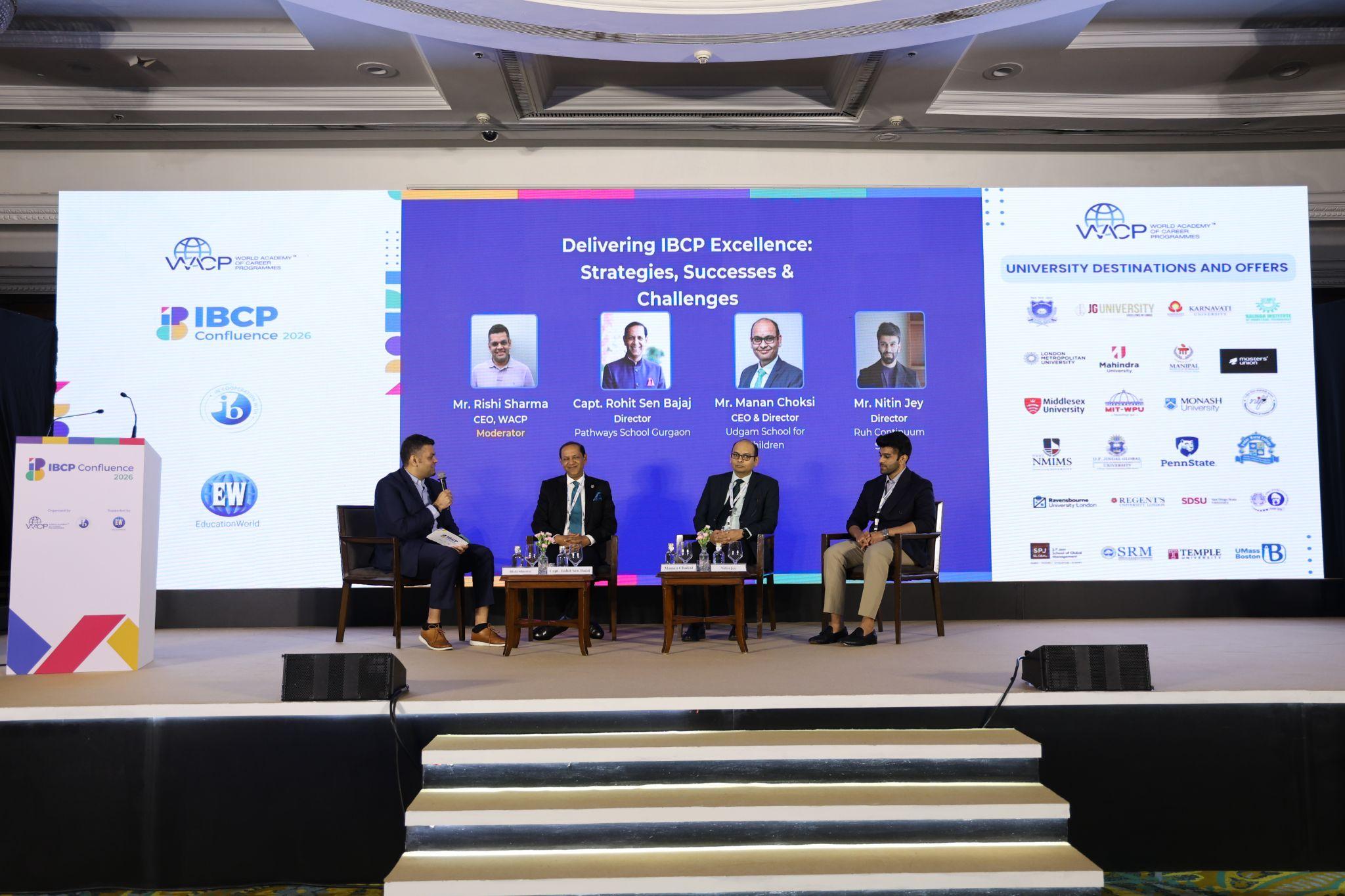
At IBCP Confluence 2026 organised by World Academy of Career Programmes ( WACP) in Mumbai, a story kept repeating itself told in different voices, from different cities, by school directors and students alike. The details changed, but the arc was always the same: someone who didn't know where they were going, who found their direction through the IB Career-related Programme, and who hasn't looked back since.
Kanak Pandey (current CP Year 2, Aspee Nutan Academy and now founder of sustainable toy startup Baby Boo) "When I joined I was this young, timid kid who didn't really know what I was doing but I watched myself grow, and the people around me watched me grow into someone completely new. Using the knowledge from my CRS and DP subjects, I started my journey of building a line of sustainable eco-friendly toys. I have received scholarships from State University of New York, Binghamton University (Scholarship $45000) and State University of New York, University at Buffalo (Scholarship $60,000).
School leaders shared the unfiltered story of building a program that India is only just beginning to understand.
Captain Rohit Sen Bajaj, Director at Pathways School Gurgaon shared “A student, uncertain about their future, walked into a counselling session unable to name a single university they wanted to attend. Six months later, that same student was debating whether to pursue fashion design in Paris or London. "That," Bajaj said, settling back in his chair at the IBCP Confluence 2026 panel discussion, "is what passion and profession coming together actually looks like."
The Early Days: Betting on a Programme Nobody Had Heard Of
Pathways School Gurgaon was among the first schools in the country to offer the IBCP, and Capt. Bajaj was candid that the early conversations were anything but simple. The school had the advantage of already being a continuum institution running PYP, MYP, DP, and CP. But even with that infrastructure, winning hearts took deliberate effort. "We realised we had to have family conversations," Capt. Bajaj explained, stressing the word family with intention. It wasn't enough to brief parents at an orientation evening. Grandparents, siblings, and extended support systems all needed to be brought along.
Crucially, Bajaj points to the AIU recognition of the IBCP as a turning point that gave the programme institutional legitimacy in India , a prerequisite for convincing any stakeholder with a conventional mindset. He also credits the IB's own outreach during COVID, and the subsequent partnership with WACP, which introduced the school to a range of Career-Related Studies.
Alman Bansal (CP alumni, Pathways School Gurgaon, now pursuing double major Marketing & Finance at Monash University Australia) said "I always wanted to study business and CP not only helped me find my passion, it helped me feel it. It helped me come out of my shell completely; up till 10th grade I was very sheltered and anxious and never spoke up in class, but through CP I led group assignments and discussions, and that has carried into university. Even now, two semesters in, everything being taught is basically revision, I was literally using my WACP resources for my marketing unit today.”
A Positioning Puzzle
Manan Choksi, Director, UDGAM School for Children, a 60-year-old CBSE school in Ahmedabad framed his school's IBCP journey with disarming honesty. "We had no experience with IB. Neither the heads, nor the teachers," he said. The school's reputation was built on its traditional board results, and positioning a premium international programme within a community that associated "IB" primarily with overseas-bound, high-fee education required surgical precision.
The challenge, he explained, was to celebrate both pathways simultaneously. The solution was to stop competing and start targeting. The IBCP was positioned to appeal specifically to the cohort of students the school had previously been turning away bright, curious students who struggled with rote-learning structures, who had international aspirations, and whose families understood that a mark sheet alone was not a destiny. "Eligible students who could have gotten into CBSE still chose IBCP," he said. "That was the biggest win."
His metric for success, at this stage of the programme's growth, is deliberately intangible. "We are at the mindset-changing phase right now," he acknowledged. University placements and scholarships will come but the more significant transformation is in how students understand their own agency.
Manushi Choksi (current CP Year 2, Udgam School for Children) said "When I came into IBCP, I thought I knew everything about marketing but the more I learned, the more I realised how much I didn't know. CP has completely shifted my thinking; I came in certain about marketing and left equally excited about entrepreneurship. My whole CRS journey has been hands-on and practical, which is exactly what I wanted. What I truly believe now is that just because you love something doesn't mean you're good at it and WACP & IBCP have shaped me into actually being good at what I love. I received offers from Babson"
Contextualising the Programme
Nitin Jey, Director Ruh Continuum School said “IBCP's value isn't only in unlocking international university options. It's in building internationally-minded graduates who may well return home.”
Ruh built industry partnerships with local textile and manufacturing companies, integrating real sector exposure into the Career-Related Studies in business management and design. The result surprised them: family businesses began actively seeking the programme out, seeing it as a way for the next generation to build professional rigour before stepping into a legacy enterprise.
Nitin also flagged a challenge that is easy to overlook at schools where DP and CP run alongside each other: the quiet, unintentional bias of educators. Sometimes counselors or educators nudge CP students toward the Diploma, treating the CP as the lesser path. "You have to conduct a lot of orientations within the team," he said, "to help them see the possibilities." Once counselors and educators genuinely understand the transferable skills agenda the world is moving toward, the bias tends to dissolve.
Ishit Shah (CP alumni, Children's Academy International School, now at NMIMS pursuing BSc Economics) "IBCP gave me a foundation, a base to build my confidence and get clarity. When I went for university applications, I saw a clear difference between me and my peers from traditional programmes. They weren't specific about what they wanted, but I was sure, because I had already found that passion while studying the CRS. Everything I studied over those two years has continued to help me in my university studies today."
For any student standing at the crossroads of choosing a programme, or any parent wondering whether the IBCP is the right bet, the answer from those who have lived it is remarkably consistent. It isn't about which board is better or which path looks more prestigious on paper. It is about whether two years of schooling will simply prepare your child for an exam, or fundamentally change how they see themselves and the world. The young people who have been through the programme don't talk about marks or rankings they talk about discovering passions they didn't know they had, building confidence they didn't know they were capable of, and arriving at university already thinking like professionals. The IBCP does not hand students a future. It does something harder and more valuable, it helps them choose one for themselves.